
Every learning experience starts with these questions…
Who is the learner?
K-5 classroom teachers who care deeply about their students and want to use technology with purpose, not just because a device showed up in their classroom one day. They range from early-career teachers still building their practice to veterans who have seen every ed-tech trend come and go. What they share is this: they want what is best for their kids, and they want to actually understand the tools they are being asked to use.
Why does it matter to them?
“For teachers to dramatically increase their use of technology, they will need technology coaching, someone whose job it is to find the best technologies and show them how to use them and integrate them in the most effective ways. Otherwise, teachers just don't have time in their busy schedules to keep up on the best technology practices and resources."
That was true when I wrote it during my MS in Educational Technology, and it is still true today. The tools have changed. The need hasn't.
Background
Technology in and of itself is not going to save our educational system. But when designed and leveraged with intention, it has the potential to transform it. These projects grew out of fifteen years of teaching K-5 students and coaching teachers, and a consistent observation: schools get the devices before they get the design thinking. The result is technology that sits in carts, professional development that evaporates by Monday morning, and teachers who feel overwhelmed rather than supported.
This page brings together video work and instructional materials created across different contexts and audiences, all grounded in the same design question: what does it look like when a teacher truly understands not just how to use a tool, but why it matters for the learner in front of them?
Edtech portfolio overview
A guided tour of my educational technology philosophy, background, and approach
20th vs 21st Century Classroom
What does learning actually look like when technology is integrated with intention versus when it isn't? This video sets the frame for everything that follows.
Explainer video LAN to WAN
From Local Area Network to Wide Area Network. I created this video to show students how they get online at their school site. It is also a model for the kind of multimedia lesson a teacher can create to make invisible infrastructure visible and meaningful for young learners. Making the complex accessible is the core of the work.
Google LM for Teachers
A practical walkthrough for educators on using Google NotebookLM as a thought partner and planning tool. Designed for teachers who want to work smarter without losing their own professional judgment in the process.
Digital “poster board” tutorial
A step-by-step tutorial for teachers on building digital pasteboards as a learning and sharing tool in the classroom.
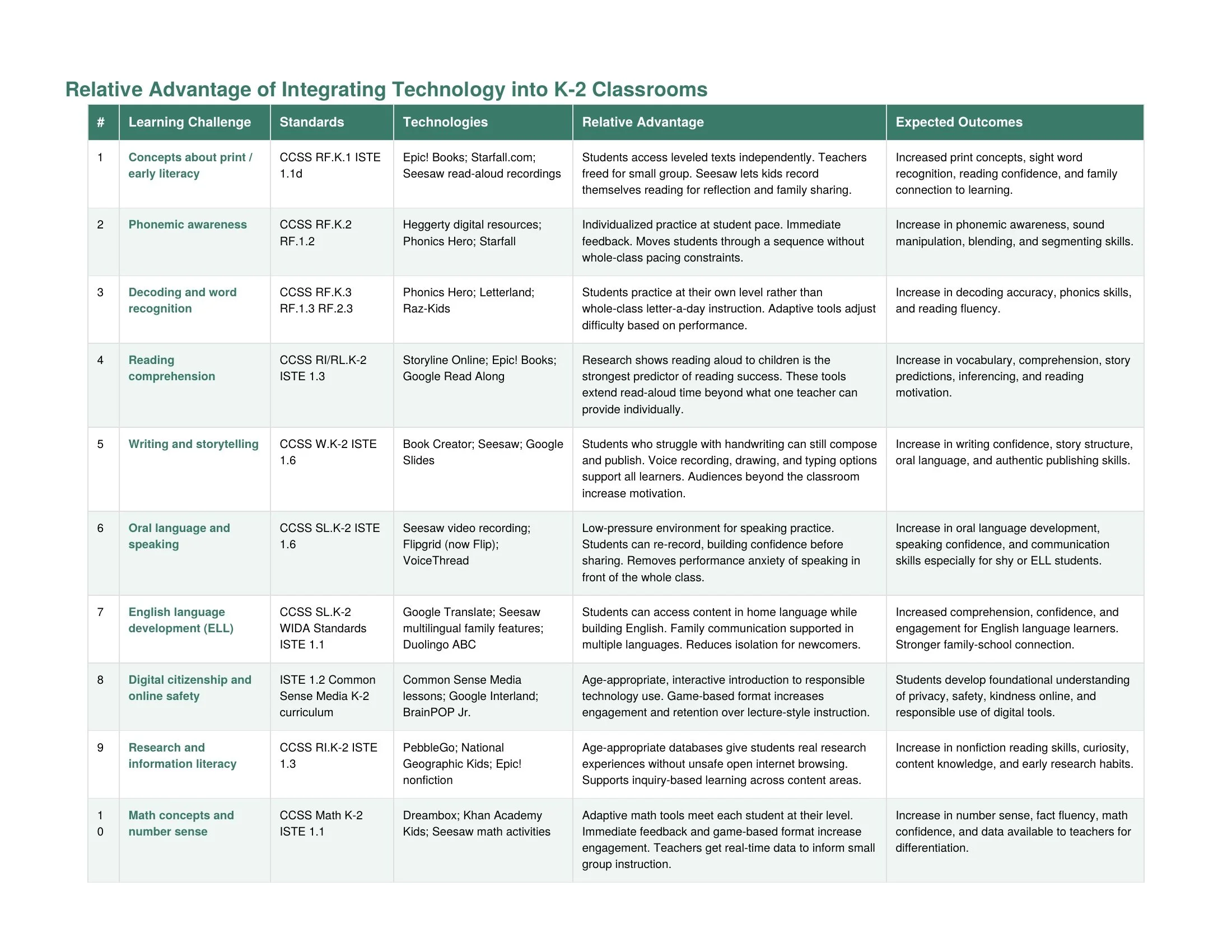
Relative Advantage: Purposeful Technology integration in the K-2 Classroom
This chart maps K-2 standards to specific technologies, outlines the relative advantage of each over traditional methods, and projects expected learning outcomes. It is an early example of the analysis thinking that runs through all of my ID work: start with the learner and the standard, then choose the tool.
Reflection
Learning theory must drive technology integration. Many schools get caught up in the newest, latest, flashiest hardware or software, but they don't implement it in a strategic way, or it just doesn't support solid learning theory, and so is not very effective.
I feel confident in my ability to seek out new technologies, master them, and present them to other teachers and peers. The technologies will change, but this ability to find, master, and incorporate whatever the latest technology is will be the key to success.
The through line across all of this work is the same question I bring to every project: who is the learner, and why does this matter to them? In a K-12 context that question has two answers at once, the child in the room and the teacher designing for them. Getting both right is the whole job.