
Every learning experience starts with these questions…
Who is the learner?
College students studying social work, psychology, and counseling, volunteering as near-peer mentors to high schoolers in rural Valley County, Idaho. A place where many students would be the first in their families to go to college. They're students inspired to make a difference in their community, they want to make a positive impact, and they are relatable. Their intentions are strong, but they are not confident in mentoring....yet.
Why does this matter to them?
These new mentors “get it” because many of them lived it. For these young mentees, without someone who can relate and show them the way, college and mental health careers seem out of reach. Research reflects this impact: first-generation students with a college-going mentor are nearly twice as likely to enroll themselves (Glass, 2022), and near-peer mentors who participate in structured programs show stronger college persistence outcomes, especially for students of color and low-income students (McCallen et al., 2023). In Valley County, Idaho, ranked 50th in the nation for primary care providers per capita, the impact of these mentors can have lasting and rippling effects for the entire state.
“Throughout this project I kept a running reflection journal as part of my graduate coursework. The quotes you’ll see throughout this page are excerpts from that process.”
Background
MHCA is a 14-month pilot program matching Valley County 11th and 12th graders with college students studying social work, psychology, and counseling. The near-peer model is intentional: research on social capital shows that knowing someone personally who has navigated college is one of the strongest predictors of whether a first-generation student will get there themselves.
Our team was brought in to design the mentor onboarding from scratch. Our mission was clear: one 60-minute virtual session, a guidebook, no prior cohort to learn from, and a program still being built while we designed for it.
Analysis
We conducted a Training Requirements Analysis, Learner and Environmental Analysis, and Task Analysis. The most important information came from active listening, a skill we would also be teaching the mentors.
“We started out searching for articles on near-peer mentoring and then shifted when our client told us the main goal was mentors modeling what it’s like to be a college student, since many mentees are from rural areas and may be first generation to go to college. That shift deepened our thinking and changed our direction.”
That conversation reframed the entire design. This wasn't primarily a simple skills transfer problem. It reflects a need for more awareness and support of the mental health professions and inspiring young people who come from rural, less affluent areas that they not only can make a difference but their background will be an asset in connecting with clients who come from similar struggles.
The client also highlighted an important tension. Mentors are college students studying mental health, but not yet clinicians. We needed to draw a clear line between mentoring and therapy. We needed to support mentors in maintaining clear boundaries while also developing active listening skills. And we needed to prepare them for what to do if a situation arose that required escalation and additional support.
“Even though we knew our deliverable was a 60-minute training, we kept designing around what the client actually needed and asking questions along the way that deepened her thinking and shifted our direction as we went.”
Lesson Plan
Sixty minutes was a time constraint that we felt could be solved by creating a guidebook that mentors could take with them and reference throughout their time as mentors. The most important part of the training centered around making real time peer to peer connections, practicing role plays, and thinking through scenarios with the support of the trainers.
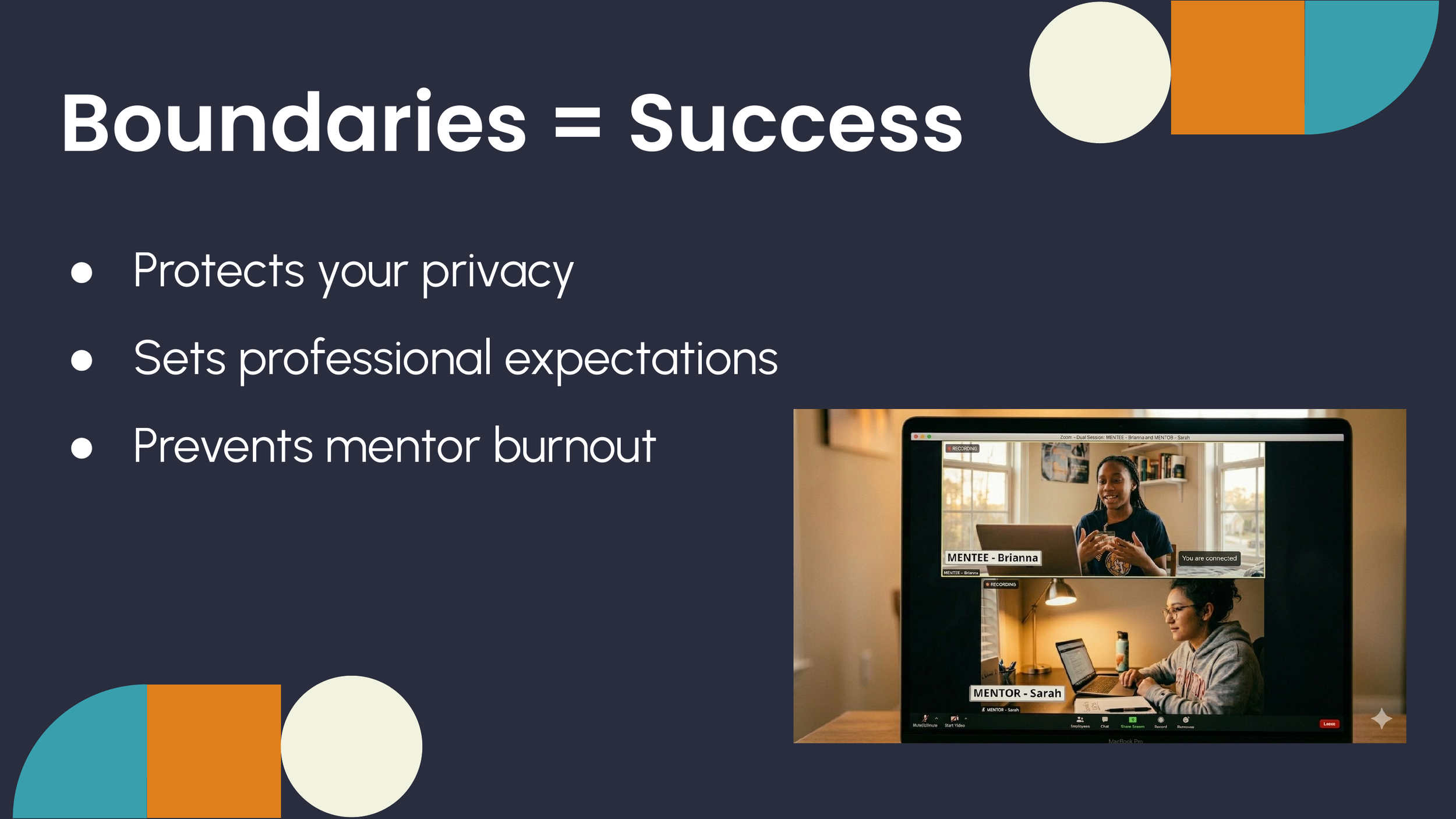
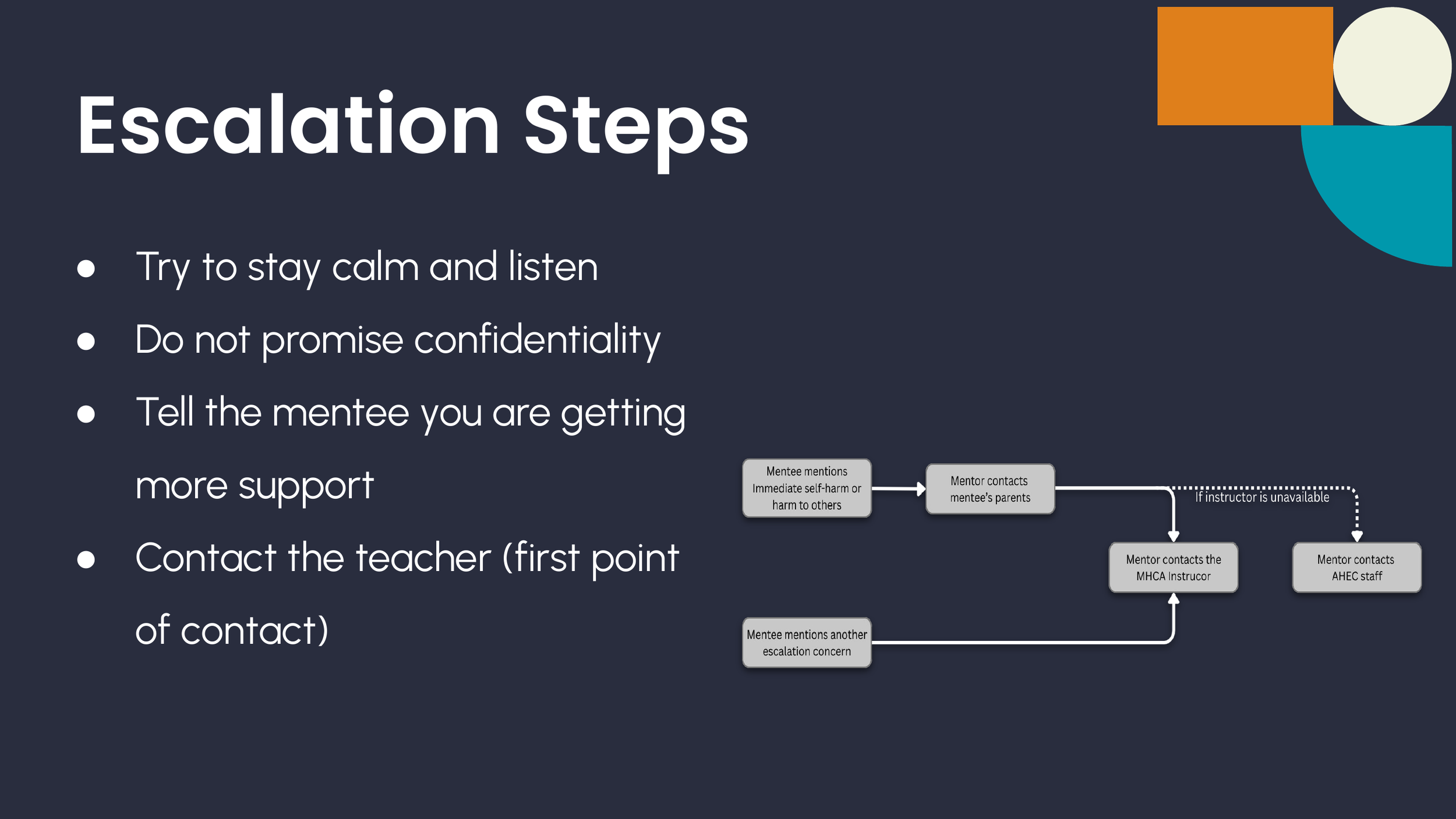
Sequencing of topics in a training matters. Adults engage more fully when they are internally driven by the "why," so we opened with it: the AHEC mission, the near-peer research, and the actual stakes for Valley County students. Active listening followed, the key skill to mentoring. Boundaries came third, where mentors practiced real scenarios through Zoom polls, deciding in real time whether a situation was a mentor action or a boundary violation. Escalation brought the highest stakes, with mentors working through a scenario in breakout rooms using the escalation job aid to map out the reporting path. The session closed with a guidebook scavenger hunt, giving mentors hands-on practice navigating the resource they would carry with them for the next 14 months.
Immediate feedback during role plays and scenarios allowed mentors to course correct in real time, one of the most effective learning strategies for adults. The guidebook was designed to lower cognitive load, giving mentors a reliable reference they could reach for in the moment rather than trying to memorize everything in a single session.
Instructional Materials
Three core materials came out of this project, each designed with a specific purpose.
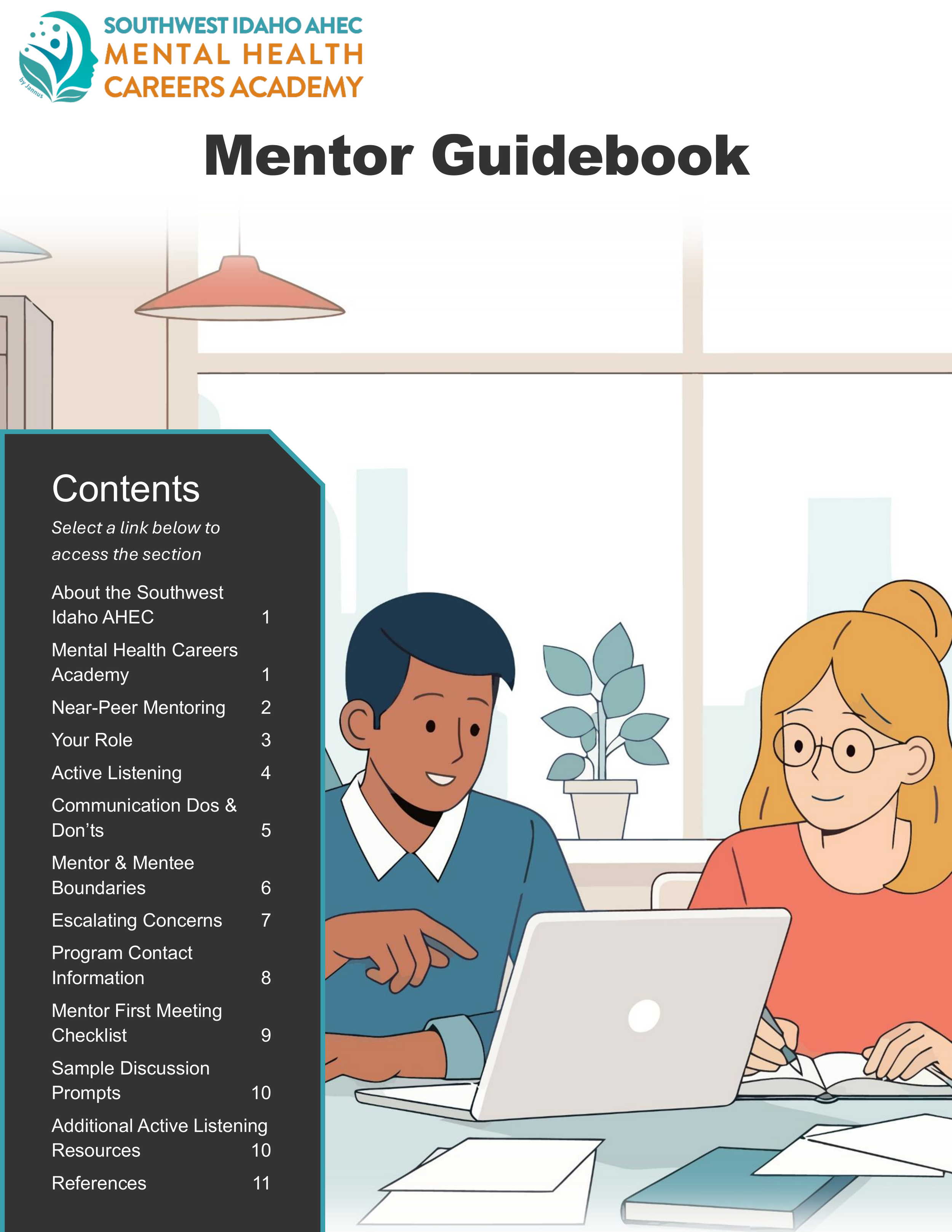
The Mentor Guidebook was designed to be an easily accessible and easily searchable resource as mentors traveled through this 14-month experience. A clickable table of contents lets mentors navigate in the moment, during a session, or before deciding whether to escalate a concern. View the Mentor Guidebook
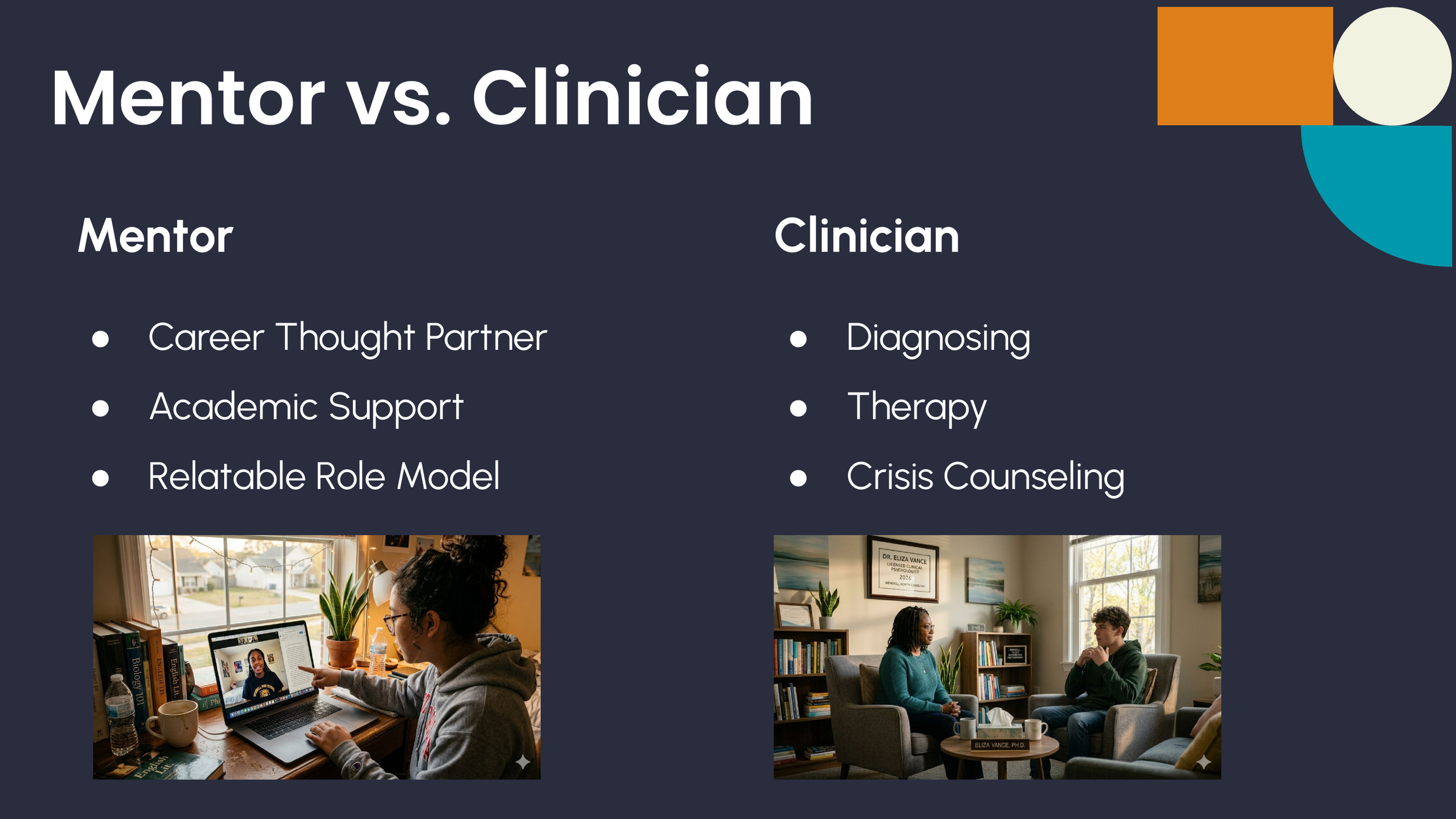
The onboarding slides presented real life scenarios the mentors might encounter. The breakout rooms gave mentors and trainers space to role play, building confidence and supporting them in making judgment calls. Photography was generated using Gemini to reflect the virtual mentoring context and the actual demographic of the students this program serves, rather than relying on stock imagery that didn't represent them. View the Onboarding Slides
The Lesson Plan structured the full 60-minute session, sequencing activities to build the mentors confidence before adding complexity, and ensuring every minute had a purpose. It was designed to support trainers in using the full session effectively and to be editable for future year trainings as the program grows.
Reflection
“There is ‘school mode’ where we have hypothetical best-case scenarios, and then there is the real world where the client doesn’t necessarily have all the answers to the questions we have, and there isn’t one perfect ID tool to use that we can fill in perfectly.”
This project confirmed something I've known since my days as an instructional coach: the frameworks are essential, but they don't replace active listening. We used the BEM, a Training Requirements Analysis, a Learner and Environmental Analysis, and a Task Analysis.
“It’s important to have a lot of tools in your toolbox and know how to use them, because no project is going to fit neatly into just one.”
The most important design decisions came from client conversations where we asked the right question at the right moment, processed, reflected, and pivoted.
Designing for a new program taught me to plan into the future. Every material we created was designed to be edited and updated as the program grows and changes. This is important since as a nonprofit every dollar is counted.
I also used AI as a thought partner throughout this project. I remembered from my years teaching in Oakland that knowing someone in college directly impacts whether a young person goes themselves, so I was able to explore that with AI, found out it connects to the concept of Social Capital, and got resources I then verified on my own. I used Google NotebookLM to listen to a podcast about it, which is just how my brain learns best. I asked AI to ask me deeper questions and to be my active listening partner, helping me process my thinking rather than generate content for me.
“At this point it’s hard to even see the AI lines since it shows up in search overviews, writing suggestions, even email tone prompts. For someone like me who did all of this on my own until this year, it genuinely just makes things easier. If I didn’t have so much experience doing it on my own though, I can see the concern about relying on it too much.”
The final decisions, the voice, and the design rationale are mine and my team's. That distinction matters, and it's one I'll carry into every project.